
An agent’s ultimate goal is to be rational, and different environments require the agent to have different architectures to achieve this.
Agent Rationality
An agent is rational if it acts (iii) to achieve (i) the best expected outcome based on the evidence provided by its percept sequence (iv) and whatever built-in knowledge (ii) it possesses.
These were the 4 pillars of rationality;
- having an objective performance measure,
- having prior knowledge of its environment/s,
- knowing the specific actions it can perform,
- having a record of previous percepts (percept sequence).
There are generally 4 tiers of architectures (in increasing complexity).
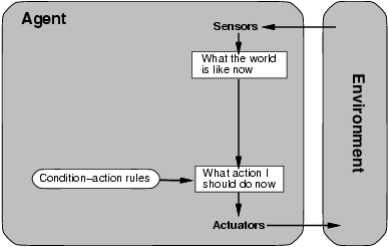
(1) Simple Reflex Agents
Environments they can Operate in
Only very simple and predictable ones.
- fully observable,
- deterministic,
- and episodic.
What it takes to be Rational
Two column
Left
It’s enough to just map current percepts to immediate actions using condition-action rules.
Right
(2) Model-Based Reflex Agents
New Environments they can Operate in
Partially observable environments.
- (e.g., an environment in which their sensors can get obscured)
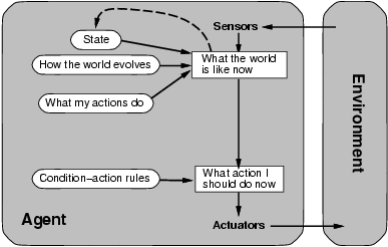
Which means they needs to track how the world is evolving to constantly have an accurate representation of it.
What it takes to be Rational
Two column
Left
They must be physically built with a model-based architecture, that is, they must maintain an internal state (a memory of past percepts and actions).
Right
(3) Goal-Based Agents
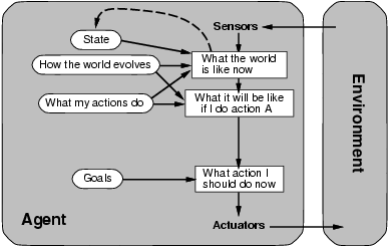
Instead of having static condition-action rules that lead to different states, they have an explicit goal state they want to reach and actively navigate their state space to reach it.
They do this navigation by continuously testing (planning ahead) how close taking an action brings them to the goal before taking it.
What it takes to be Rational
Two column
Left
Having an explicit representation of what a goal is, and how to reach it (using a search tree).
Right
Cons
- Navigating the state space via planning ahead can be computationally expensive.
(4) Utility-Based Agents
New Environments they can Operate in
Environments that are,
- stochastic (non-deterministic)
- where actions don’t guarantee outcomes, forcing the agent to calculate the expected success of a decision.
- and require having multiple (often conflicting) factors/utilities that require making trade-offs.
- (like navigating a city quickly but also safely)
What it takes to be Rational
Two column
Left
Not merely reaching a goal state, but reaching the one that best balances between a set of factors (utilities) that must be respected in a problem.
Right
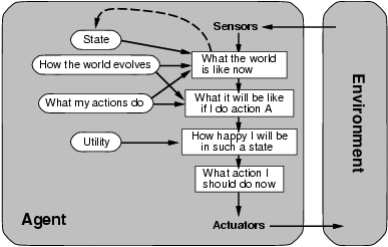
They do it by evaluating a state based on a utility value that is calculated by weighing the importance of reaching the goal + a bunch of utility factors.
Related Notes
| Thumbnail | Note | Type |
|---|